How Poker Positions Influence Your Decisions at the Table
In the game of poker, few strategic concepts carry as much weight as table position. Beginners often focus almost entirely on the absolute strength of their two hole cards, believing that premium holdings like pocket aces or kings are the sole drivers of long-term profitability. Experienced players, however, recognize that the order in which participants act on each betting round is frequently more influential than the cards themselves.
Position represents information, and information is the most valuable currency in poker. Acting after your opponents grants a clear window into their intentions, betting tendencies, and range strength before you commit a single chip. By understanding how your seat relative to the dealer button dictates starting hand selection, bluffing efficiency, pot control, and value extraction, you can transform your positional awareness into a substantial edge over the table.
The Taxonomy of Poker Table Positions
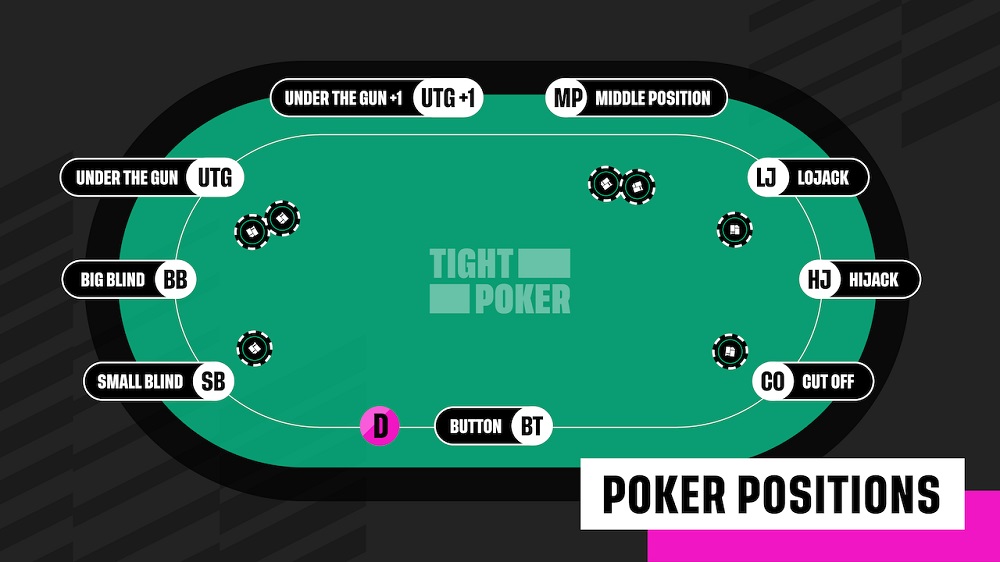
To execute a position-based strategy, it is essential to understand the categorization of seats at a standard nine-handed or six-handed table. The dealer button acts as the anchor point that rotates clockwise around the table after every hand, shifting positional advantages dynamically throughout a session.
Table seats are divided into four primary positional groups:
-
Early Position (Under the Gun and UTG+1): The player directly to the left of the big blind sits Under the Gun. This seat acts first before the flop and must make decisions with the maximum number of active players remaining behind them.
-
Middle Position (Lowjack and Hijack): These seats act after early position but before the late-stage players. While offering more freedom than early position, participants in these seats still risk facing raises from the strongest positions at the table.
-
Late Position (Cutoff and Button): The Cutoff and the Dealer Button represent the most advantageous seats. Acting last on post-flop rounds allows these players to play wider ranges and dictate the pace of the game.
-
The Blinds (Small Blind and Big Blind): While the blinds act late during the pre-flop round, they are forced into out-of-position play on every subsequent betting round (the flop, turn, and river), making them the statistically least profitable seats at the table.
Recognizing the strengths and limitations of each distinct seat provides the framework for solid pre-flop hand selection and confident post-flop execution.
The Information Asymmetry of Late Position
The fundamental benefit of having position is the accumulation of real-time intelligence. When you sit on the button or cutoff, every player ahead of you must reveal a crucial piece of data before the action reaches you: they must check, bet, raise, or fold.
Operating with this information advantage provides several tactical benefits:
-
Accurate range assessment: A check from an early position player signals potential weakness or a desire to control the pot size. Conversely, a confident bet signals strength or polarization. You can process these actions and adjust your response accordingly.
-
Closing the betting action: The final player to act has the option to take a free card by checking back, or to apply maximum pressure by betting when opponents appear vulnerable.
-
Minimizing costly mistakes: When you act last, you never face the uncertainty of an unexpected check-raise lurking behind you, allowing you to execute bluffs and value bets with much higher certainty.
Acting last effectively turns poker into an open-book test, allowing you to react to proven actions rather than guessing what opponents might do behind you.
Adjusting Starting Hand Ranges by Position
A critical error amateur players make is playing a static range of starting hands regardless of seat location. A hand like King-Jack offsuit or Ace-Ten offsuit might be profitable from the button, but opening with those exact same cards from Under the Gun is a mathematically proven money-losing play over the long run.
Positional range expansion follows clear strategic boundaries:
-
Tight ranges in early position: In early position, your opening range must consist strictly of premium holdings like high pocket pairs (tens through aces) and strong broadways (such as Ace-King and Ace-Queen). Because six to eight players act after you, the probability that someone behind holds a dominant hand is statistically elevated.
-
Moderate expansion in middle position: From middle position, you can begin introducing suited connectors (like 9-8 suited or 8-7 suited) and medium pocket pairs (sevens and eights), as fewer players remain to contest the pot.
-
Aggressive widening in late position: On the button and cutoff, you can raise with thirty to forty percent of all starting hands. This includes weak suited aces, one-gap suited connectors, and unsuited broadway cards, leveraging your post-flop positional advantage to outplay opponents.
-
Defensive play in the blinds: Despite receiving discounted entry on the big blind, defending too broadly with offsuit trash leads to difficult post-flop spots where you will be forced to play out of position without the betting lead.
Adjusting your hand requirements based on seat location prevents you from getting trapped in bloated pots with marginal holdings from inferior positions.
Pot Control and Value Extraction
Position gives a player direct command over the ultimate size of the pot. When you have position, you dictate whether a hand remains small and controlled or escalates into a massive showdown for entire chip stacks.
Controlling the pot from in position works through two primary mechanisms:
-
Securing free cards: If you hold a drawing hand (such as a four-flush or open-ended straight draw) and your opponent checks to you on the turn, checking behind allows you to see the river card for free, realizing your equity without risking further chips.
-
Maximizing value on strong hands: When you hold a monster hand in late position, you can bet the exact sizing that your opponent is likely to call based on their previous actions. On the river, being in position ensures you get one final opportunity to place a targeted value bet after the opponent checks.
-
Preventing opponent manipulation: When you are out of position, checking often invites a bet from an aggressive opponent, forcing you into difficult defensive decisions without knowing their true strength.
Having position allows you to extract every possible chip when ahead and exit cheaply when the board runs out unfavorably.
Bluffing and Float Play Dynamics
Bluffing without position is one of the highest-risk maneuvers in poker. If your out-of-position bluff is called, you are forced to navigate the turn and river blindly. In position, however, bluffing becomes an efficient, mathematically supported tool.
Key positional bluffing concepts include:
-
Floating the flop: Floating involves calling an opponent pre-flop continuation bet with a weak hand or draw, intending to take the pot away on the turn after they show weakness by checking.
-
Positional leverage on scare cards: When an overcard, flush completion, or straight-pairing card lands on the board and the out-of-position player checks, you can execute a credible bluff that credibly represents that dangerous card.
-
Stealing the blinds: Late-position steals occur when all players fold to the cutoff or button, who then places a modest raise to claim the dead money in the small and big blinds. Because the blinds will be out of position post-flop, they fold a large percentage of their holdings.
Using position to execute well-timed bluffs increases your win rate without requiring premium cards at showdown.
Frequently Asked Questions
Why is playing from the small blind considered worse than the big blind?
Although both blinds suffer from being out of position on post-flop rounds, the small blind acts before the big blind on every post-flop street, making it the absolute first player to act. Furthermore, the small blind does not get the closing discount that the big blind receives against pre-flop raises, resulting in the lowest win rate of any seat at the table.
What does it mean to have relative position during a multi-way pot?
Relative position refers to your location relative to the pre-flop aggressor rather than just the dealer button. If the pre-flop raiser sits directly to your right, you have excellent relative position because when they bet, all other players must act before you, allowing you to see the entire field reaction before making your move.
How does stack size impact positional strategy in tournament poker?
Short stacks (under twenty big blinds) reduce the value of position because play is reduced to all-in shoves or folds before the flop, limiting the opportunity for multi-street post-flop maneuvering. Deep stacks (over one hundred big blinds) dramatically increase the value of position, as navigating large bets on the turn and river requires maximum information.
What is the isolation raise technique from late position?
An isolation raise occurs when an early or middle position player limps into the pot (calls the big blind), and a player in late position raises significantly to force other players to fold. This isolates the limper into a heads-up pot where the late-position player has both the initiative and the positional advantage.
Can skilled players overcome poor table position through hand reading alone?
While elite players can navigate out-of-position situations better than amateurs, no player can completely erase the mathematical deficit of acting first. Even top-tier professionals lose money from the blinds over large sample sizes; their skill lies in minimizing those losses while maximizing profits from the cutoff and button.
How should you adjust your strategy when aggressive players sit directly to your left?
When aggressive, loose players sit to your left, they have direct position on you for the majority of hands. To counter this, tighten your starting hand requirements from early and middle position, utilize more check-calling and check-raising lines to trap their aggression, and avoid playing marginal, speculative hands that are difficult to defend out of position.